
|
|
|
Basic Information |
|
| Status: | British Overseas Territory |
| Area: | 153 sq km (59 sq miles) |
| Population: | 27,000 (estimate for 2005) |
| Capital City: | Road Town, Tortola |
| Languages: | English |
| Religion: | Christian |
| Currency: | US Dollar |
| Major political parties: | National Democratic Party (NDP), Virgin Islands Party (VIP), United Party (UP) |
| Governor: | Tom Macan |
| Chief Minister: | The Hon Dr Orlando Smith |
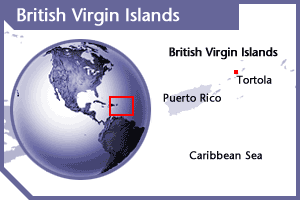
The British Virgin Islands are adjacent to the US Virgin Islands (USVI) and 60 miles east of Puerto Rico. The BVI comprises over 40 islands, islets and cays (some little more than rocks) with a total land area of only 59 sq miles scattered over some 1,330 sq miles of sea. Sixteen of the islands are inhabited, the largest being Tortola (21 sq miles), Anegada (15 sq miles), Virgin Gorda (8 sq miles) and Jost van Dyke (3.4 sq miles). Lush vegetation, sandy beaches, numerous yachting marinas and fine coral reefs make the islands a natural tourist destination.
Discovered by Columbus in 1493, the islands came into British possession in 1666 when planters took control from the original Dutch settlers. The islands were annexed by the British in 1672. In 1872 they were incorporated into the British colony of the Leeward Islands. These islands were administered under a federal system until 1956 when the Federation was dissolved. The Governor of the Leeward Islands continued to run BVI until 1960 when an appointed Administrator (later a Governor) assumed direct responsibility.
The present Constitution came into force in 1977, and was amended in 2000. The BVI is a British Overseas Territory with a large measure of internal self-government. The Governor has direct responsibility for external affairs, defence and internal security (including the Police), the Public Service and the administration of the courts. The Constitution provides for a ministerial system of government headed by the Chief Minister, an Executive Council (ExCo) chaired by the Governor, and Legislative Council (LegCo).
Elections were held on 16 June 2003. The National Democratic Party (NDP) won eight seats, beating the Virgin Islands Party (VIP), which won five seats and had formed the Government since 1985. Dr Orlando Smith became Chief Minister.
Elections are held at least every 4 years. The next election should take place in 2007.
Governor: Tom Macan
Head of the Governor's Office: Duncan Norman
Staff Officer: Sue Cotton
Personal Assistant: Helen Kay
Government House
PO Box 702
Road Town
Tortola
British Virgin Islands
Tel: 00 1 284 494 2345/2370
Fax: 00 1 284 494 5790
Office of the Deputy Governor:
Deputy Governor: Dancia Penn
Government Administration Building
Road Town
Tortola
Tel: 00 1 284 468 0346
Fax: 00 1 284 494 6481
Chief Minister: The Hon Dr Orlando Smith
Deputy Chief Minister, Minster of Finance, and Minister of Health and Welfare: The Hon Ronnie W Skelton
Minister of Communication and Works: The Hon J Alvin Christopher
Minister of Natural Resources and Labour: Eileene Parsons
Minister of Education and Culture: The Hon Lloyd Black
The Hon Cherno Jallow
GDP per capita:$38,643 (2003)
Annual Growth:1.88% (2003)
Inflation:1.036% (2003)
Major Industries:tourism, international financial services
Major trading partners:US Virgin Islands, and the USA
Exchange rate:UK£1 = US$1.8
The British Virgin Islands enjoy a close relationship with the other Caribbean Overseas Territories. Whilst the influence of neighbouring USVI is strong (US education and satellite TV), the BVI continues to value its association with the UK, which is regarded as an important aspect of the country's personality, making it distinct from the USVI.
HMG is responsible for BVI's external relations. The BVI is an associate member of the Organisation of Eastern Caribbean States (OECS) and the Caribbean Community (CARICOM).
HMG is responsible for BVI's external relations, defence and internal security. The principal point of contact is Overseas Territories Department (Foreign and Commonwealth Office), and the Governor’s Office, Road Town, Tortola.
Mrs Lorna Smith, Director
The Government of the British Virgin Islands,
15 Upper Grosvenor Street,
London
W1K 7PJ
Tel: 0207 355 9570/2
Fax: 0207 355 9575
None
UK exports to the BVI: £13.94 million (2003).
BVI exports to the UK: £32.64 million (2003).
From 1st April the British Trade Office in San Juan, Puerto Rico, will
no longer be responsible for trade promotion in the BVI.
Overseas Territories are expected to comply with their obligations under the international human rights instruments which have been extended to them. The following major human rights conventions have been extended to the British Virgin Islands:
Problems associated with drug trafficking are potentially the most serious threat to stability in the BVI. The territory is a major target for traffickers because of its numerous small uninhabited islands and close proximity to the USVI and Puerto Rico, which serve as gateways to the US mainland. Britain has provided a police launch, and jointly funds with the British Virgin Islands Government a number of British personnel, and other anti-narcotics equipment to assist counter-drug activity.
The BVI has a full Mutual Legal Assistance Treaty (MLAT) with the US and enjoy close co-operation with US law enforcement agencies. The Drug Trafficking Offences Bill - similar to UK legislation permitting seizure of assets – was passed in 1992, and a Criminal Justice International Co-operation Act was introduced in 1993. New legislation (2003) on money laundering covers all crimes, not just drug related crimes, thereby bringing the BVI into line with UK legislation.